Nordic standards and adhesive compliance in medical device manufacturing
Across the Nordic region, sustainability requirements are moving faster than in most of Europe. For medical device manufacturers, that pressure is increasingly landing on material specifications, including the adhesives used in incise films, wound care dressings, surgical drapes, wearables, ostomy flanges and negative pressure wound therapy applications.
Standards like the Nordic Swan Ecolabel are shaping what goes into products and how they're assembled. For medical device teams, that sits alongside requirements they already manage closely, such as ICH Q3C guidelines restricting residual solvents to 890 parts per million maximum and California's Proposition 65.
What's actually changing
The regulatory shift in the Nordics isn't just about tighter limits. It's about direction. REACH enforcement is intensifying and regulations across Sweden, Denmark and Norway are all increasing transparency requirements. Customers in the region increasingly request full documentation: SDS, LCA data and certification readiness as standard, on top of the regulatory files device manufacturers already maintain for markets like the US.
For adhesive users, the practical implication is this: solvent-based systems that were compliant five years ago may no longer be, or require more documentation to prove they do.
Where adhesives fit into the compliance picture
Adhesives are a small part of most medical device assemblies by weight, but a disproportionate contributor to VOC emissions. In patient-contact applications, that isn't only a compliance question. Residual solvents can affect skin irritation and pain scores during removal, which matters directly for wearables worn over days, wound dressings, ostomy flanges and incise films.
Making the transition practical
The business case for switching isn't only regulatory. For teams under pressure to demonstrate sustainability progress alongside clinical performance, the emissions and documentation profile of solvent-free UV acrylic technology is an auditable improvement, not just a claim.
The transition requires upfront evaluation. Substrate compatibility, application conditions and performance requirements all need to be mapped against existing device validation. But for most standard applications, solvent-free alternatives exist that meet or exceed the performance of the systems they replace.
Watch the session
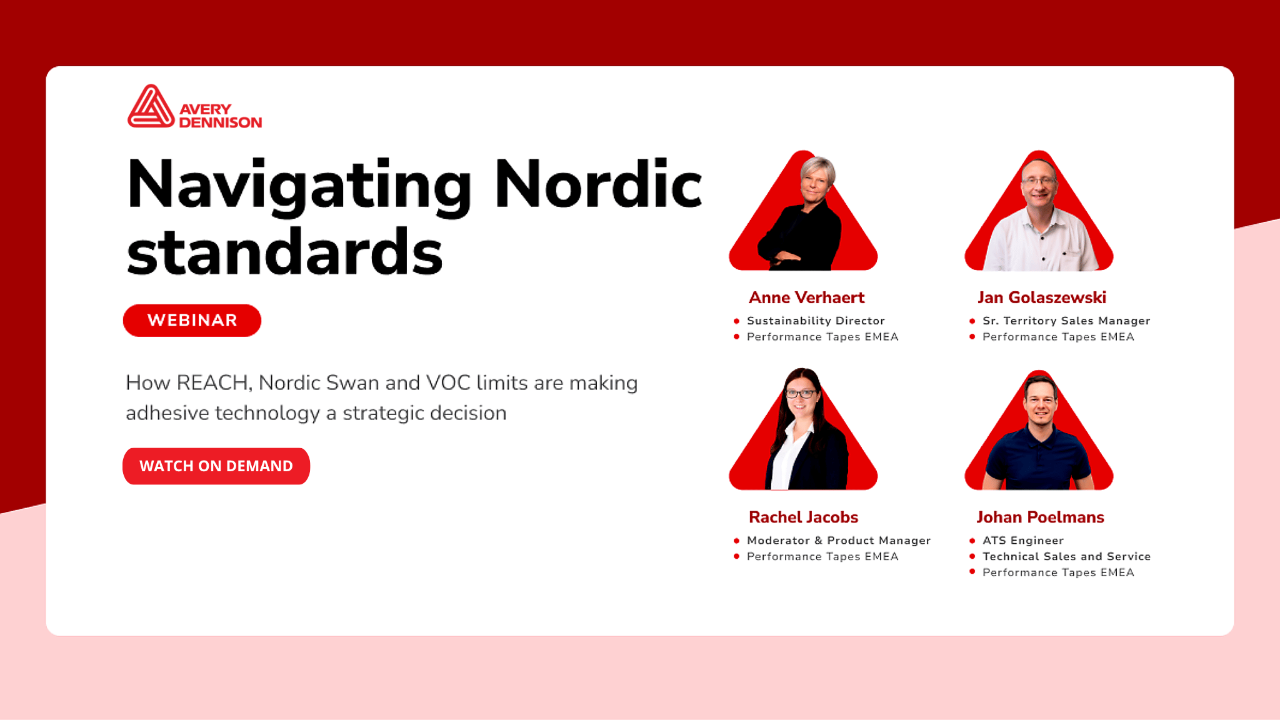
We covered the regulatory landscape, real-world application scenarios and the decision criteria for transitioning to solvent-free systems in a recent webinar. The regulatory and technology story applies directly to medical device manufacturing.

About the author
Rachel Jacobs
Product Manager Performance Tapes, Medical
Rachel has been part of Avery Dennison since 2011, building expertise across customer service, sales coordination and product management, all from the Medical tapes site in Turnhout, Belgium. She holds a Master's in Multilingual Communication (magna cum laude), which comes in handy when teaming up with customers, R&D and cross-functional partners to manage the full Medical tapes portfolio for Performance Tapes Europe.
LinkedIn | Email Rachel at medical.solutions@averydennison.com